
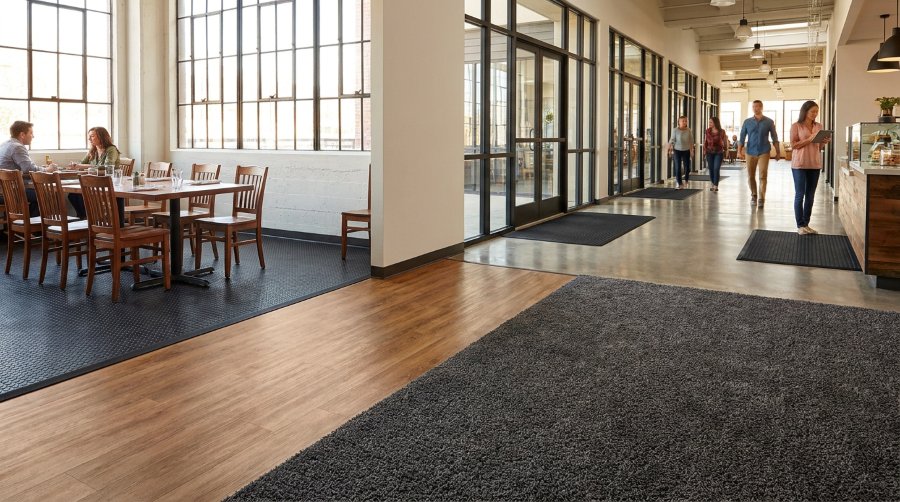
Selecting the right flooring mat is rarely just an aesthetic choice. Whether mitigating slip-and-fall hazards in high-traffic shopping centers, providing acoustic dampening in corporate boardrooms, or trapping moisture in home entryways, floor mats serve critical functional roles.
This comprehensive guide breaks down the essential types of flooring mats, primary materials, technical dimensions, budget versus premium tiers, and ideal applications across commercial and residential spaces.
1. Key Types of Flooring Mats & Functional Applications
Flooring mats fall into distinct functional categories engineered for specific operational demands:
- Entrance & Scraper Mats: Positioned at primary ingress points to scrape heavy mud, grit, and debris off footwear before it reaches internal floors.
- Moisture-Absorptive & Wiper Mats: Placed immediately inside entryways following scrapers to capture residual water and fine dust particles.
- Anti-Fatigue Mats: High-density, resilient mats engineered to reduce foot, leg, and lumbar fatigue for personnel standing for extended shifts.
- Acoustic & Heavy Commercial Carpet Tiles/Runners: Modular floor coverings designed to absorb airborne foot-traffic noise and maintain an executive aesthetic.
- Heavy-Duty Interlocking Drainage Mats: Perforated mats that elevate foot traffic above wet, greasy, or spill-prone subsurfaces.
2. Material Breakdown: Durability, Grip, and Maintenance
| Material | Key Strengths | Limitations | Best Used For |
| Natural Coir (Coconut Fiber) | Aggressive dirt scraping, classic visual appeal | Sheds fibers, absorbs water heavily, slow drying | Exterior residential doorways, boutique entries |
| Nitrile / SBR Rubber | Oil/grease resistant, slip-proof backing, curl-resistant | Heavier profile, industrial look | Commercial kitchens, food prep zones, wet ramps |
| PVC / Polyvinyl (Spaghetti / Coil) | Traps dirt within hollow coils, easily washed with hose | Can degrade under harsh UV or freezing temperatures | Mall thresholds, outdoor office entrances, swimming decks |
| Polypropylene / Solution-Dyed Nylon | Rapid water absorption, stain-resistant, holds dyes | Requires frequent vacuuming or extraction | Corporate lobbies, banquet hallways, retail corridors |
| EVA Foam (Ethylene-Vinyl Acetate) | Lightweight, shock-absorbing, modular interlocking | Susceptible to heavy furniture indentation, low puncture resistance | Home gyms, playrooms, pop-up indoor party stalls |
3. Selecting the Right Mat by Space
Office Spaces
- Primary Needs: Cable concealment, chair-caster glide, acoustic reduction, executive appeal.
- Best Choice: Low-profile polypropylene carpet runners for corridors, PVC chair mats for workstations, and beveled-edge nylon wiper mats at building elevator banks.
Restaurants & Commercial Kitchens
- Primary Needs: Grease resistance, slip protection, drainage, and anti-fatigue relief.
- Best Choice: Perforated heavy-duty nitrile rubber mats behind the bar and cookline; moisture-absorbent charcoal barrier runners in host stations.
Party Halls & Banquet Venues
- Primary Needs: High aesthetic cohesion, sound baffling, stain resilience against beverage spills, quick turnaround cleaning.
- Best Choice: Heavy polypropylene ribbed runner mats for service hallways, luxury modular carpet tile mats with liquid-barrier backings for banquet reception lobbies.
Shopping Malls & Retail Plazas
- Primary Needs: Extreme volume footfall, rolling load support (strollers, carts, wheelchairs), maximum debris scraping.
- Best Choice: Recessed architectural aluminum grid mats with replaceable nylon/carpet inserts, combined with extended PVC spaghetti coil runners across vestibules.
Residential Homes
- Primary Needs: Visual warmth, ease of hand-washing, hardwood floor protection, kitchen anti-fatigue.
- Best Choice: Dual-action coir/rubber entry door mats, closed-cell polyurethane anti-fatigue runner mats near kitchen sinks, and low-pile washable cotton/microfiber runners.
4. Standard Sizes and Form Factors
Flooring mats are manufactured in standard ready-to-use footprints, continuous rolls, and modular configurations:
- Standard Entryway Sizes:
- $1.5 \text{ ft} \times 2.5 \text{ ft}$ ($45 \times 75 \text{ cm}$) — Standard residential doorways.
- $2 \text{ ft} \times 3 \text{ ft}$ ($60 \times 90 \text{ cm}$) — Larger home entrances, office cabin doors.
- $3 \text{ ft} \times 5 \text{ ft}$ ($90 \times 150 \text{ cm}$) — Commercial double doors, restaurant host podiums.
- Continuous Runners (Rolls):
- Widths of $3 \text{ ft}$, $4 \text{ ft}$, and $6 \text{ ft}$ ($90 \text{ cm}$ to $180 \text{ cm}$), cut to custom lengths up to $50 \text{ ft}$ ($15 \text{ m}$) for hotel aisles, party hall corridors, and mall entry vestibules.
- Modular Interlocking Tiles:
- $1 \text{ ft} \times 1 \text{ ft}$ ($30 \times 30 \text{ cm}$) and $3 \text{ ft} \times 3 \text{ ft}$ ($90 \times 90 \text{ cm}$) snap-together rubber or PVC tiles configured for irregular floor layouts.
5. Budget vs. Premium: Pricing and Value Comparison
| Tier | Typical Price Range | Common Materials | Typical Lifespan | Value Proposition |
| Budget Tier | ₹150 – ₹600 ($2 – $8) per mat / ₹25 – ₹45 per sq. ft. | Basic PVC coil, recycled rubber crumbs, lightweight thin coir | 6 to 18 months | Low upfront capital, suited for small households, temporary stalls, or short-lease retail setups. |
| Mid-Range Tier | ₹700 – ₹2,500 ($9 – $30) per mat / ₹60 – ₹120 per sq. ft. | Vulcanized SBR rubber, needle-punch polypropylene, heavy vinyl backing | 2 to 4 years | Standard commercial performance; balances washability and slip safety for regular offices and cafes. |
| Premium Tier | ₹3,000 – ₹12,000+ ($35 – $150+) / ₹180 – ₹450+ per sq. ft. | 100% Virgin Nitrile rubber, high-twist solution-dyed nylon, architectural recessed aluminium grilles | 5 to 10+ years | Superior life-cycle economy, fire-rated, ADA-compliant beveled ramp edges, impervious to heavy trolley rolling loads. |
Technical Checklist Before Placing an Order
- Check Ramp Edges: Ensure mats selected for public spaces (malls, halls, offices) feature certified beveled or ramped safety borders to prevent trip hazards and comply with accessibility standards.
- Backing Compatibility: Use non-staining rubber backings over polished marble, hardwood, or vitrified tiles to avoid chemical migration and yellowing.
- Traffic Rule-of-Thumb: High-traffic public entrances (malls and banquet halls) require a minimum of 6 to 10 paces (approx. $15 \text{ ft} \text{ to } 20 \text{ ft}$) of continuous matting to trap up to 85% of footwear moisture and grit before it damages interior floors.
Resource Credit: Developed in collaboration with HousingMaterial.com, India's dedicated construction materials, machinery, and specialized civil procurement network.